How to Deal with the Rise of AI in Your Business
AI isn’t coming for your business. It’s already here. So how do you deal with it?

AI isn’t coming for your business. It’s already here. So how do you deal with it?
If you’ve been following business news—or any news—lately, you’ve probably noticed that artificial intelligence has moved from science fiction to boardroom discussion at breakneck speed. What seemed like futuristic technology just a few years ago is now prompting some business owners to lose sleep wondering if they’re about to be left behind.
Or worse, replaced entirely.
Here’s the thing: AI is already here, so pretending it doesn’t exist won’t make it go away. But contrary to the doom-and-gloom headlines, it doesn’t have to be an existential threat to your livelihood.
In fact, for most businesses, it represents one of the most significant opportunities for competitive advantage we’ve seen in decades.
Read that again.
Let’s cut through the hype and fear, and attempt to understand what AI actually means for your business and how to navigate this transformation strategically.
Before you can effectively deal with AI in your business, you need to understand what we’re actually talking about. AI today isn’t the sentient robots of Hollywood movies (that’s still a decade away, at least).
The AI that you need to deal with right now is software that can recognize patterns, process language, analyze data, and automate tasks that previously required human judgment.
Current AI applications include:
The key insight: AI excels at repetitive cognitive tasks and processing vast amounts of information quickly.
It struggles with genuine creativity, complex human relationships, ethical judgment, and adapting to truly novel situations.
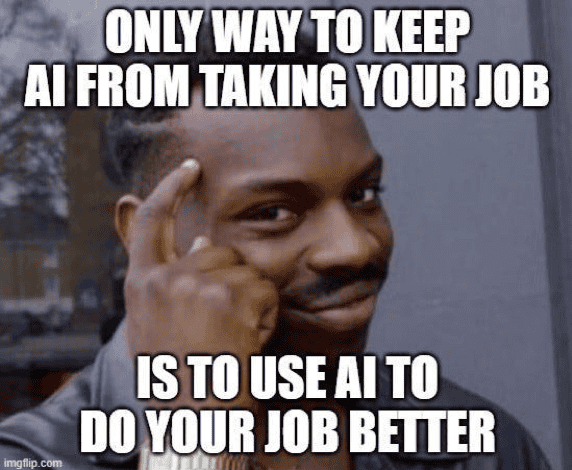
AI is changing business as we know it.
Productivity gains are real.
A 2023 study by MIT and Stanford found that customer service workers using AI assistance resolved 14% more issues per hour, with customer satisfaction scores improving significantly. Similar productivity gains are appearing across industries—from legal research to software development to advertising.
What this means: Businesses that adopt AI tools effectively can do more with the same resources, or maintain output with fewer resources.
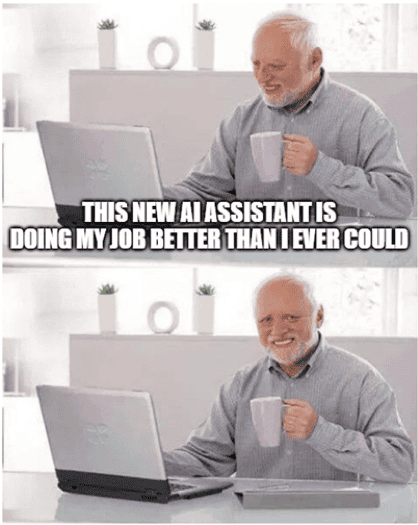
Competitive dynamics are shifting.
Your competitors who embrace AI effectively will be able to operate with lower costs, faster response times, and more personalized service. The competitive gap between AI adopters and non-adopters is widening quickly.
What this means: Ignoring AI isn’t a viable long-term strategy. You don’t need to be on the cutting edge, but you can’t afford to be left behind entirely.
Customer expectations are evolving.
As consumers interact with AI-powered services in their personal devices, they increasingly expect similar experiences from all businesses—instant customer support, personalized recommendations, and rapid response times.
What this means: The baseline for acceptable customer experience is rising, and AI is often necessary to meet these new standards economically.
Different businesses face different AI opportunities and challenges. Let’s break down practical approaches by business category…
AI can handle much of the routine analytical work that traditionally filled billable hours—document review, research, basic analysis, and template-based deliverables.
Your Strategic Response:
Real-world example: A small accounting firm implemented AI-powered bookkeeping automation and document processing. Rather than replacing staff, they redirected their team’s time toward advisory services, increasing average client fees by 35% while improving client satisfaction.
AI is transforming inventory management, pricing optimization, customer service, and personalized marketing for online and offline retail businesses.
Your Strategic Response:
Real-world example: A regional retailer implemented AI-driven demand forecasting and reduced inventory carrying costs by 22% while simultaneously decreasing out-of-stock items. The result? They managed to improve profit margins by over 3%, which was a miracle in their industry.
AI is impacting ordering systems, inventory management, staffing optimization, and customer engagement in the food and restaurant industry.
Your Strategic Response:
Key consideration: In food service, the human experience—hospitality, creativity, and personal connection—remains your primary differentiator. Use AI to eliminate friction, not replace the human touch.
In manufacturing, AI is revolutionizing quality control, predictive maintenance, supply chain optimization, and production planning.
Your Strategic Response:
Real-world example: A mid-sized manufacturer implemented AI-powered predictive maintenance on their production line, reducing unplanned downtime by 40% and extending equipment life by an estimated 15%.
AI is improving scheduling, routing, customer communication, and pricing optimization for independent consultants and contractors in fields as varied as trucking and construction.
Your Strategic Response:
Key consideration: Reliability, expertise, and trustworthiness remain your core values. Use AI to be more efficient and responsive, not to replace the skilled human judgment that customers value.
AI is most accessible to small retailers through existing platforms such as POS systems, online selling apps, and social media tools.
Your Strategic Response:
Key consideration: As a small business, your personal relationships and community connection are your competitive advantage. Use AI to be more efficient so you have more time for what makes you special.
No matter which industry you’re in…
We can help you get a loan that suits YOUR line of business.
Regardless of your business type, here’s a practical framework for approaching AI:
Identify which tasks in your business are:
These are your prime candidates for AI assistance.
Don’t try to transform your entire business overnight. Pick one specific problem or process and find an AI solution for it. Learn, adapt, and then expand to other areas.
Start with widely-adopted, proven tools rather than cutting-edge experimental technology. Let others work out the bugs.
Your employees need to understand that AI is a tool to enhance their work, not replace them. Provide training on new AI tools and help your team develop skills that complement AI rather than compete with it.
Skills that become more valuable alongside AI:
Identify what makes your business uniquely valuable in human terms—relationships, specialized expertise, creativity, local knowledge, trustworthiness—and double down on these while using AI to handle everything else more efficiently.
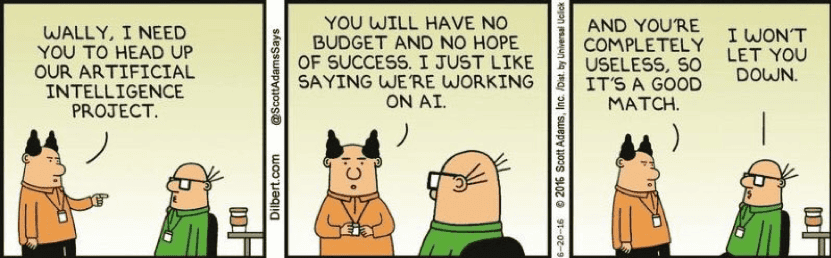
Image credit: Dilbert.com by @ScottAdamSays
Track the impact of AI tools you implement. Are they actually saving time? Reducing costs? Improving customer satisfaction? Be willing to abandon tools that don’t deliver value and expand those that do.
From a cash flow and financing perspective, AI adoption presents both opportunities and considerations:
Investment Requirements: Most AI tools today operate on subscription models, making them accessible without major upfront capital investments. However, training time, process changes, and potential workflow disruptions have real costs.
ROI Timeline: Productivity improvements from AI tools often materialize quickly—within 3-6 months. However, realizing the full strategic benefits typically takes 1-2 years as you optimize processes and workflows. Make sure you calculate the ROI on your AI investments and efforts.
Competitive Pressure: Businesses that don’t invest in basic AI capabilities may find themselves at an increasing cost disadvantage, potentially requiring larger investments later to catch up.
As you navigate AI adoption, avoid these common mistakes:
Don’t adopt AI just because everyone else is. Choose tools that solve real problems in your business, not because they’re trendy.
Don’t assume AI will replace human judgment. AI is a tool that requires human oversight, especially for important decisions.
Don’t neglect data security and privacy. Many AI tools process sensitive business and customer data. Understand how your data is used and protected.
Don’t forget about your customers. Some customers appreciate AI efficiency; others value human interaction. Find the right balance for your customer base.
Don’t stop learning. AI technology evolves rapidly. Stay informed about new capabilities that might benefit your business.
The rise of AI in business is neither the apocalypse nor a magic solution. It’s a powerful set of tools that can make your business more efficient, more responsive, and more competitive—provided you approach it strategically.
The businesses that will thrive in an AI-enabled economy are those that:
You don’t need to become an AI expert or transform your business overnight. You just need to start paying attention, experiment thoughtfully, and continuously look for opportunities to work smarter rather than harder.
The question isn’t whether AI will impact your business—it already is. The question is whether you’ll harness it strategically or let it pass you by.
Will AI replace my business or my employees?
Not very likely. AI excels at repetitive tasks and data processing but struggles with creativity, complex relationships, and ethical judgment. Most businesses should use AI to handle routine work, freeing employees to focus on higher-value activities that require expertise and human insights.
How much does it cost to implement AI in my business?
Most AI tools today use subscription models, typically ranging from $20-$100 monthly depending on features and scale. This makes AI accessible without major upfront capital. The bigger investment is usually training time and workflow adjustments during the first 3-6 months.
Where should I start with AI adoption?
Start small. Identify one repetitive, time-consuming, or data-intensive task in your business. Find a proven AI tool that addresses it specifically. Learn from this first implementation, measure results, then gradually expand to other areas once you’re comfortable.
What if my competitors adopt AI before I do?
Companies using AI effectively will operate with lower costs, faster response times, and better service. While you don’t need cutting-edge technology, ignoring AI entirely puts you at an increasing competitive disadvantage. Start with proven tools now rather than playing catch-up later.
How do I know which AI tools are legitimate vs. hype?
Focus on widely-adopted tools rather than experimental technology. Look for specific use cases similar to yours, check user reviews, and start with free trials. Measure actual results—time saved, costs reduced, satisfaction improved—not just features promised.
Will my customers accept AI-powered services?
It depends on your customers and implementation. Many customers appreciate faster response times and 24/7 availability. However, maintain human options for complex issues. The key is using AI to eliminate friction while preserving the human connection that builds loyalty and trust.
How long before I see ROI from AI investments?
Productivity improvements often appear within 3-6 months as teams learn the tools. Full strategic benefits—optimized workflows, competitive advantages, significant cost reductions—typically materialize over 12-18 months. Track specific metrics from day one to measure progress and adjust your approach.
What does YOUR business need funds for right now?
New equipment? Expansion? Increasing team strength?
 https://goqualifi.com/wp-content/uploads/2026/03/Restaurant-Financing-101-From-Food-Trucks-to-Fine-Dining.webp
341
512
faras@brandmaximise.com
https://goqualifi.com/wp-content/uploads/2024/01/qualifi-new-logo-300x106.jpg
faras@brandmaximise.com2026-03-23 23:16:292026-03-23 23:16:31Restaurant Financing 101: From Food Trucks to Fine Dining – Complete guide to funding options for every stage of restaurant growth
https://goqualifi.com/wp-content/uploads/2026/03/Restaurant-Financing-101-From-Food-Trucks-to-Fine-Dining.webp
341
512
faras@brandmaximise.com
https://goqualifi.com/wp-content/uploads/2024/01/qualifi-new-logo-300x106.jpg
faras@brandmaximise.com2026-03-23 23:16:292026-03-23 23:16:31Restaurant Financing 101: From Food Trucks to Fine Dining – Complete guide to funding options for every stage of restaurant growth https://goqualifi.com/wp-content/uploads/2026/03/What-13-Years-in-Alternative-Lending-Taught-Us-About-Small-Business.webp
393
650
faras@brandmaximise.com
https://goqualifi.com/wp-content/uploads/2024/01/qualifi-new-logo-300x106.jpg
faras@brandmaximise.com2026-03-23 23:07:192026-03-23 23:07:21What 13 Years in Alternative Lending Taught Us About Small Business
https://goqualifi.com/wp-content/uploads/2026/03/What-13-Years-in-Alternative-Lending-Taught-Us-About-Small-Business.webp
393
650
faras@brandmaximise.com
https://goqualifi.com/wp-content/uploads/2024/01/qualifi-new-logo-300x106.jpg
faras@brandmaximise.com2026-03-23 23:07:192026-03-23 23:07:21What 13 Years in Alternative Lending Taught Us About Small Business https://goqualifi.com/wp-content/uploads/2026/03/Your-Businesss-Financial-Health-Check-10-Key-Metrics-That-Actually-Matter.png
382
680
faras@brandmaximise.com
https://goqualifi.com/wp-content/uploads/2024/01/qualifi-new-logo-300x106.jpg
faras@brandmaximise.com2026-03-21 23:26:382026-03-21 23:26:41Your Business’s Financial Health Check: 10 Key Metrics That Actually Matter
https://goqualifi.com/wp-content/uploads/2026/03/Your-Businesss-Financial-Health-Check-10-Key-Metrics-That-Actually-Matter.png
382
680
faras@brandmaximise.com
https://goqualifi.com/wp-content/uploads/2024/01/qualifi-new-logo-300x106.jpg
faras@brandmaximise.com2026-03-21 23:26:382026-03-21 23:26:41Your Business’s Financial Health Check: 10 Key Metrics That Actually Matter https://goqualifi.com/wp-content/uploads/2026/03/Beyond-Banks-Why-Alternative-Lending-Might-Be-Your-Best-Option.jpg
382
706
faras@brandmaximise.com
https://goqualifi.com/wp-content/uploads/2024/01/qualifi-new-logo-300x106.jpg
faras@brandmaximise.com2026-03-21 23:15:482026-03-21 23:28:36Beyond Banks: Why Alternative Lending Might Be Your Best Option
https://goqualifi.com/wp-content/uploads/2026/03/Beyond-Banks-Why-Alternative-Lending-Might-Be-Your-Best-Option.jpg
382
706
faras@brandmaximise.com
https://goqualifi.com/wp-content/uploads/2024/01/qualifi-new-logo-300x106.jpg
faras@brandmaximise.com2026-03-21 23:15:482026-03-21 23:28:36Beyond Banks: Why Alternative Lending Might Be Your Best Option https://goqualifi.com/wp-content/uploads/2026/03/Labor-Market-Tight-How-to-Finance-Employee-Retention-and-Recruitment.png
449
800
faras@brandmaximise.com
https://goqualifi.com/wp-content/uploads/2024/01/qualifi-new-logo-300x106.jpg
faras@brandmaximise.com2026-03-19 14:00:002026-03-19 11:47:15Labor Market Tight? How to Finance Employee Retention and Recruitment
https://goqualifi.com/wp-content/uploads/2026/03/Labor-Market-Tight-How-to-Finance-Employee-Retention-and-Recruitment.png
449
800
faras@brandmaximise.com
https://goqualifi.com/wp-content/uploads/2024/01/qualifi-new-logo-300x106.jpg
faras@brandmaximise.com2026-03-19 14:00:002026-03-19 11:47:15Labor Market Tight? How to Finance Employee Retention and Recruitment https://goqualifi.com/wp-content/uploads/2026/03/Emergency-Business-Funding-When-You-Need-Capital-Now-Fast-funding-options-for-urgent-needs.jpg
551
1000
faras@brandmaximise.com
https://goqualifi.com/wp-content/uploads/2024/01/qualifi-new-logo-300x106.jpg
faras@brandmaximise.com2026-03-19 11:37:112026-03-19 11:37:14Emergency Business Funding: When You Need Capital Now – Fast funding options for urgent needs
https://goqualifi.com/wp-content/uploads/2026/03/Emergency-Business-Funding-When-You-Need-Capital-Now-Fast-funding-options-for-urgent-needs.jpg
551
1000
faras@brandmaximise.com
https://goqualifi.com/wp-content/uploads/2024/01/qualifi-new-logo-300x106.jpg
faras@brandmaximise.com2026-03-19 11:37:112026-03-19 11:37:14Emergency Business Funding: When You Need Capital Now – Fast funding options for urgent needs https://goqualifi.com/wp-content/uploads/2026/03/How-to-Inflation-Proof-Your-Business-Financial-Strategies-for-Uncertain-Times.webp
1080
1920
faras@brandmaximise.com
https://goqualifi.com/wp-content/uploads/2024/01/qualifi-new-logo-300x106.jpg
faras@brandmaximise.com2026-03-18 13:30:002026-03-18 11:19:16How to Inflation-Proof Your Business: Financial Strategies for Uncertain Times
https://goqualifi.com/wp-content/uploads/2026/03/How-to-Inflation-Proof-Your-Business-Financial-Strategies-for-Uncertain-Times.webp
1080
1920
faras@brandmaximise.com
https://goqualifi.com/wp-content/uploads/2024/01/qualifi-new-logo-300x106.jpg
faras@brandmaximise.com2026-03-18 13:30:002026-03-18 11:19:16How to Inflation-Proof Your Business: Financial Strategies for Uncertain Times https://goqualifi.com/wp-content/uploads/2026/03/Understanding-the-Effects-of-Fed-Rate-Hikes-on-Small-Business-Financing-1.webp
775
1200
faras@brandmaximise.com
https://goqualifi.com/wp-content/uploads/2024/01/qualifi-new-logo-300x106.jpg
faras@brandmaximise.com2026-03-18 11:05:302026-03-18 11:05:33Understanding the Effects of Fed Rate Hikes on Small Business Financing
https://goqualifi.com/wp-content/uploads/2026/03/Understanding-the-Effects-of-Fed-Rate-Hikes-on-Small-Business-Financing-1.webp
775
1200
faras@brandmaximise.com
https://goqualifi.com/wp-content/uploads/2024/01/qualifi-new-logo-300x106.jpg
faras@brandmaximise.com2026-03-18 11:05:302026-03-18 11:05:33Understanding the Effects of Fed Rate Hikes on Small Business Financing https://goqualifi.com/wp-content/uploads/2026/03/From-500K-to-5M-Scaling-Your-Construction-Business-the-Right-Way-1.webp
647
1379
faras@brandmaximise.com
https://goqualifi.com/wp-content/uploads/2024/01/qualifi-new-logo-300x106.jpg
faras@brandmaximise.com2026-03-17 13:00:002026-03-17 13:50:39From $500K to $5M: Scaling Your Construction Business the Right Way
https://goqualifi.com/wp-content/uploads/2026/03/From-500K-to-5M-Scaling-Your-Construction-Business-the-Right-Way-1.webp
647
1379
faras@brandmaximise.com
https://goqualifi.com/wp-content/uploads/2024/01/qualifi-new-logo-300x106.jpg
faras@brandmaximise.com2026-03-17 13:00:002026-03-17 13:50:39From $500K to $5M: Scaling Your Construction Business the Right Way