Purchase Order Financing for Small Business: The 1-2-3 Guide

When it’s critical to fulfil an order for the growth or survival of your business, you can rely on PO financing for a quick infusion of capital without diluting your capital or placing a strain on your creditworthiness.

If you’re a small business dealing in goods, you know the pain of facing cash flow challenges when trying to fulfill large purchase orders. Purchase Order (PO) financing has emerged as a vital funding solution that enables growing companies to accept larger orders without depleting their working capital. Or doing rounds of their bank for a “small business” loan.

This specialized financing option is particularly valuable in the current economic landscape—torn by supply chain disruptions and threats and counter-threats of tariffs, where supply chain flexibility and quick access to capital can make the difference between scaling successfully or choking your way to dissolution.

What is Purchase Order Financing?

Purchase Order financing is a short-term funding solution that provides the capital necessary to fulfill customer orders when your business lacks sufficient cash flow, raw material or inventory.

Say you’re a furniture manufacturer and you receive an order for 800 sets of desks and chairs. You don’t have them ready and know that you’ll never be able to pay for the wood and labour to make all those desks at the same time. Your client will pay you only after the order is delivered. What do you do?

You could consider a temporary loan, but that means taking on more debt in addition to the loans you’re already paying off and your routine monthly expenses. You might have maxed your credit limits already.

That’s where PO financing has an advantage. Unlike traditional loans and credit cards that focus on your credit history, PO financing considers the creditworthiness of your customers who placed the orders.

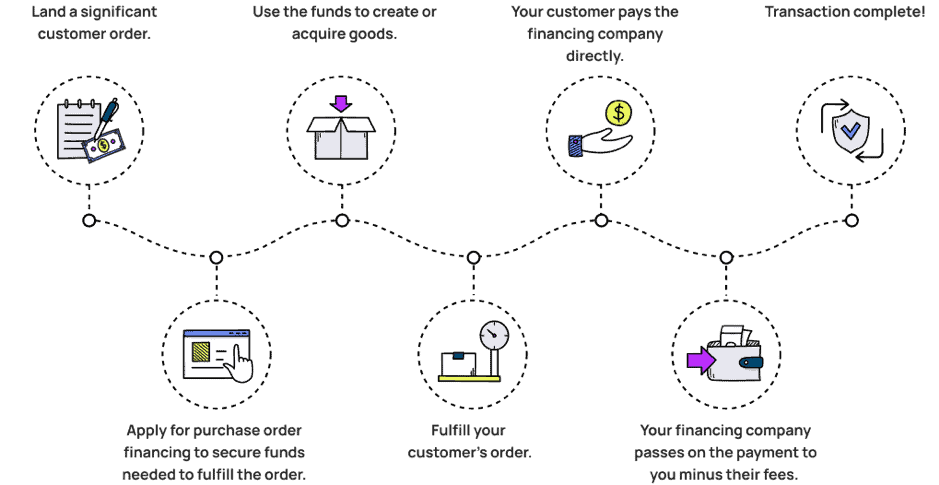
Here’s how PO financing typically works:

  1. Your business receives a purchase order from a creditworthy customer.
  2. You calculate the production, distribution or trade costs, and apply for PO financing with the order documentation.
  3. The financing company pays your suppliers directly. This is usually around 70-80% of the total cost, but can go up to 100% depending on the supplier’s track record and/or the creditworthiness of the customer.
  4. You deliver the finished goods to your customer.
  5. Your customer pays the full invoice amount to the financing company.
  6. The financing company deducts their fees and advances, then remits the remaining balance to you.

Image source: https://kapitus.com/products-services/purchase-order-financing/

Advantages of PO Financing for Small Businesses

If you run a small operation, there are some clear pluses to be had from PO financing

  1. Growth Without Equity Dilution: PO financing allows you to take on larger orders without seeking equity investors, maintaining your ownership stake while scaling operations.
  2. No Burden of Creditworthiness: Unlike traditional loans that scrutinize your business’s financial history, PO financing primarily evaluates your customer’s ability to pay, making it accessible to newer businesses with limited credit history.
  3. Quick Access to Capital: Most PO financing arrangements can be established within days rather than weeks or months typical of traditional bank loans—crucial for time-sensitive opportunities.
  4. Scales with Your Business: As your purchase orders grow in size and frequency, the financing can scale accordingly without renegotiating terms or seeking additional credit approvals.
  5. Complements Other Financing Methods: PO financing works well alongside other funding solutions like invoice factoring or equipment financing, creating a comprehensive cash flow management strategy.

Which Industries Are Best-Suited to PO Financing?

While PO financing can benefit many businesses, it’s particularly valuable for:

Manufacturing: Where materials and production costs must be covered before payment

Wholesale distribution: To bridge inventory acquisition and customer payment

Technology hardware: For financing component purchases before assembly and delivery

Seasonal businesses: To manage large order spikes without year-round credit lines

Government contractors: To fulfill public sector contracts that often have longer payment terms

Why Should You Consider PO Financing in 2025?

Today’s business landscape presents unique challenges and opportunities that make PO financing particularly relevant.

Supply chain diversification: Companies are maintaining relationships with multiple suppliers, often requiring more working capital to manage diverse procurement strategies.

US-first production: With successive governments aiming to bring back manufacturing and jobs to the US, you might need more capital to invest in production as well as people.

Global market volatility: Currency fluctuations and geopolitical tensions create both risks and opportunities for businesses with international suppliers or customers.

Digital transformation: E-commerce expansion means more businesses are handling larger order volumes with leaner operations.

Qualifi empowers businesses to fulfill large customer orders without upfront capital. This flexible funding solution helps cover supplier costs, ensuring smooth operations and growth. Ideal for businesses with confirmed purchase orders needing quick, reliable financing. Fast approvals and expert support available.

PO Financing Isn’t without Its Challenges

Before you jump right in, know that with every financing option, there are certain pitfalls, caveats and small print you need to be aware of.

  1. Higher Cost Than Traditional Financing: PO financing typically carries fees ranging anywhere from 2 to 6% of the purchase order value per month, making it more expensive than traditional bank financing but often worth the cost for the growth it enables. Further, the longer your customer takes to pay the invoice, the higher the fees go. For example, it could be 5% for the first 30 days, 10% for the next 30 days, and so on.
  2. Limited to B2B and B2G Transactions: The PO financing option generally only works for business-to-business or business-to-government transactions, not direct-to-consumer sales.
  3. Supplier Relationship Management: Your suppliers must be willing to work with the PO financing company. This needs deft communication and relationship management on your part. They might doubt your ability to deliver, to start with. Their accounts department may also be unwilling to take on additional payment processes.
  4. Partial Coverage: The PO financing company will probably cover only a percentage of your supply costs, leaving you to fend for the difference.
  5. Higher Profit Goals: PO financing companies usually require you to have a minimum margin of 20% or thereabouts. This makes it harder for you to get and deliver orders from new or big clients.
  6. Narrow Scope: PO financing is available only to pay your suppliers. You can’t use it for any other business function.

Best Practices in Fulfilling Orders with PO Financing

Know this: At Qualifi, we can help you fund order sizes up to a staggering $20 million.

And yet, it is YOU who need to fulfill it and deliver the goods at the end of the stipulated period. What things do you need to bear in mind?

  1. Determine the feasibility: Well begun is half done. Before approaching financing providers, determine the specific purchase orders you need to finance. Assess your customers’ creditworthiness since this will be crucial to approval. Evaluate your suppliers’ reliability to ensure they can deliver on time and meet quality requirements. Finally, analyze your profit margins carefully to confirm they can absorb the financing costs while still maintaining profitability on the order.
  2. Gather all necessary documentation: You need to have on hand your customers’ purchase orders (that clearly mention items, quantities, prices, payment times, etc.), your company’s financial statements, quotes from suppliers, and cost and profit estimates at a minimum.
  3. Research and compare PO financing providers: Okay, we could just ask you to call 833-933-3665 or fill up the form on this page, but the right way to do it is to thoroughly evaluate potential providers based on their fee structures, transparency, industry experience and reputation, the speed with which they can get you funding, and any additional services or support you could use.
  4. Manage the order fulfilment process: Let me remind you—well begun is only half done. After securing financing, maintain clear communication with your suppliers, customer, and financing provider throughout the process. Track the order progress meticulously to identify and address any potential issues early. Implement delivery, customer acceptance and invoicing procedures that meet everyone’s requirements to ensure a smooth handover. Finally, ensure robust risk management with contingency plans for supplier delays or quality issues, customer payment delays, currency fluctuations (for international orders), and regulatory changes.

In Conclusion

Purchase Order financing represents a strategic funding solution for small businesses looking to scale in competitive markets. By enabling you to accept larger orders without straining working capital, PO financing creates growth opportunities that might otherwise be inaccessible.

The key to successful PO financing lies in understanding its appropriate applications, carefully selecting financing partners, maintaining strong relationships with suppliers and customers, and implementing efficient processes to manage the order fulfillment cycle.

As economic conditions continue to evolve, businesses that strategically incorporate PO financing into their broader financial toolkit position themselves to respond quickly to market opportunities, outpace competitors, and build sustainable growth trajectories despite cash flow limitations.

Does Applying for a Business Line of Credit Hurt Your Credit?